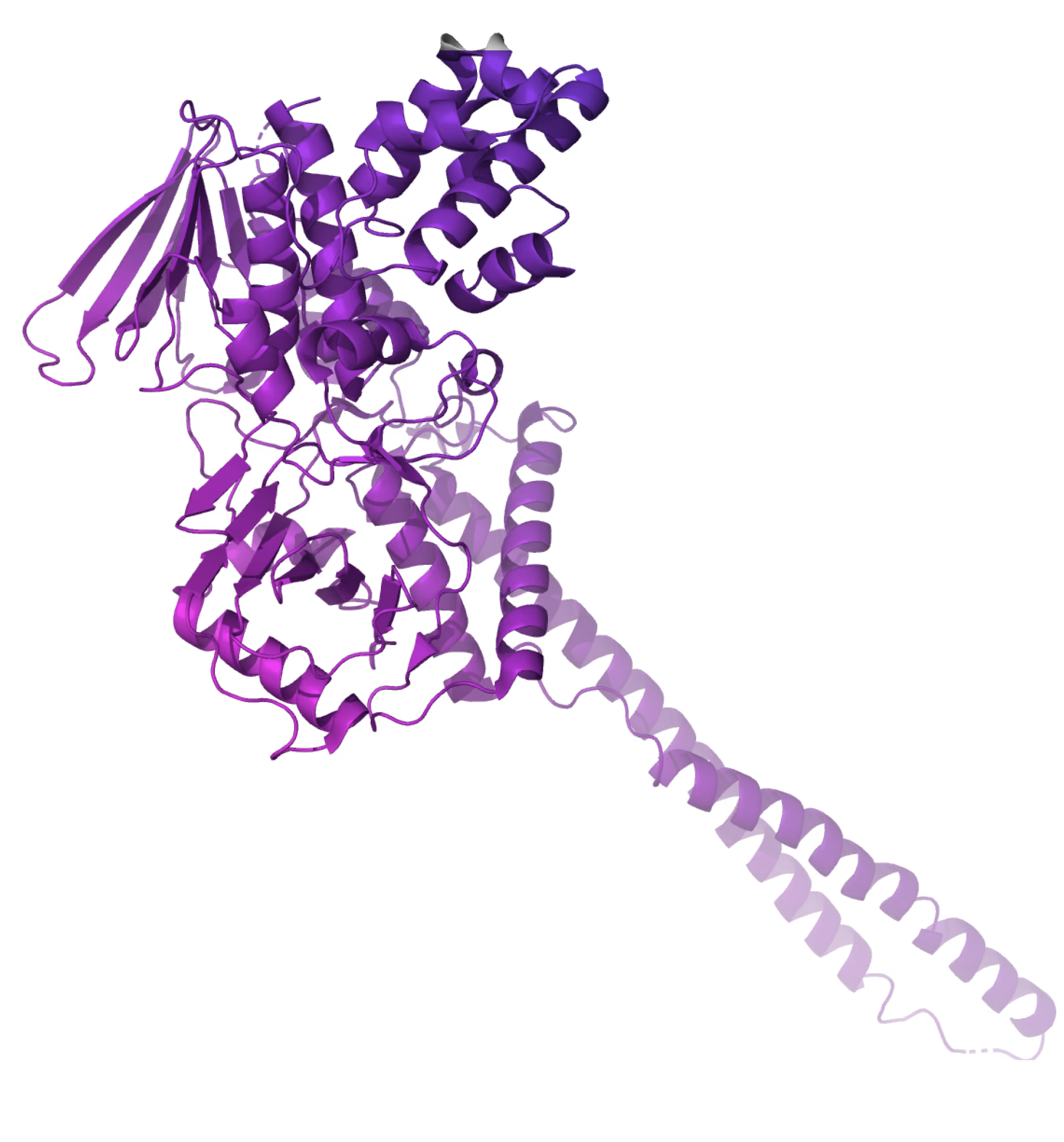
REC-4539
Solid tumors and hematology oncology
REC-4539 is the first LSD1 inhibitor designed to be both reversible and CNS-penetrant, and is being developed for multiple solid tumor and hematology indications, including small-cell lung cancer (SCLC) and acute myeloid leukemia (AML). There are currently no LSD1 inhibitors approved by the FDA. REC-4539’s combined properties distinguish it from other LSD1 inhibitors in development, with the potential to reduce adverse events seen from on-target platelet effects.
Learn more on clinicaltrials.gov
REC-4539: An LSD1 inhibitor AI-designed to address class-limiting toxicities
The challenge:
Overcoming Toxicity and Reaching the CNS
Lysine-specific demethylase 1 (LSD1) is a promising epigenetic target in aggressive cancers like small cell lung cancer (SCLC) and acute myeloid leukemia (AML). Successfully drugging LSD1 could provide a new option for the ~45,000 extensive stage SCLC patients in the US and EU5 who have progressed following frontline therapy and currently face limited options, as well as patients with certain blood cancers. Previous clinical attempts have been stalled by two critical challenges:
On-Target Toxicity
In earlier agents, irreversible binding and long half-lives resulted in severe dose-limiting toxicities, specifically dangerously low platelet counts (thrombocytopenia).
Poor CNS
Penetration
Many existing LSD1 inhibitors cannot cross the blood-brain barrier, which is a critical flaw given that over 50% of SCLC patients eventually develop brain metastases.
The unique how:
Active Learning & Differentiated Scaffolds
Addressing these specific problems was a complex chemistry design challenge, one that our combination of generative chemistry and active learning was uniquely positioned to solve. Recursion leveraged its AI-native precision design platform to move beyond the inherent biases of traditional medicinal chemistry. By employing active learning, the platform intentionally sampled unbiased, diverse chemical space to select multiple starting points. These were not only the “best” compounds for optimal predicted CNS penetrance and potency, but also counter-intuitive compounds that deviated from standard design biases - providing alternative starting points that could be optimized.
Through sampling these diverse areas of chemical space and molecules with distinct structural profiles, a novel chemical scaffold was identified. This scaffold was further refined into REC-4539.
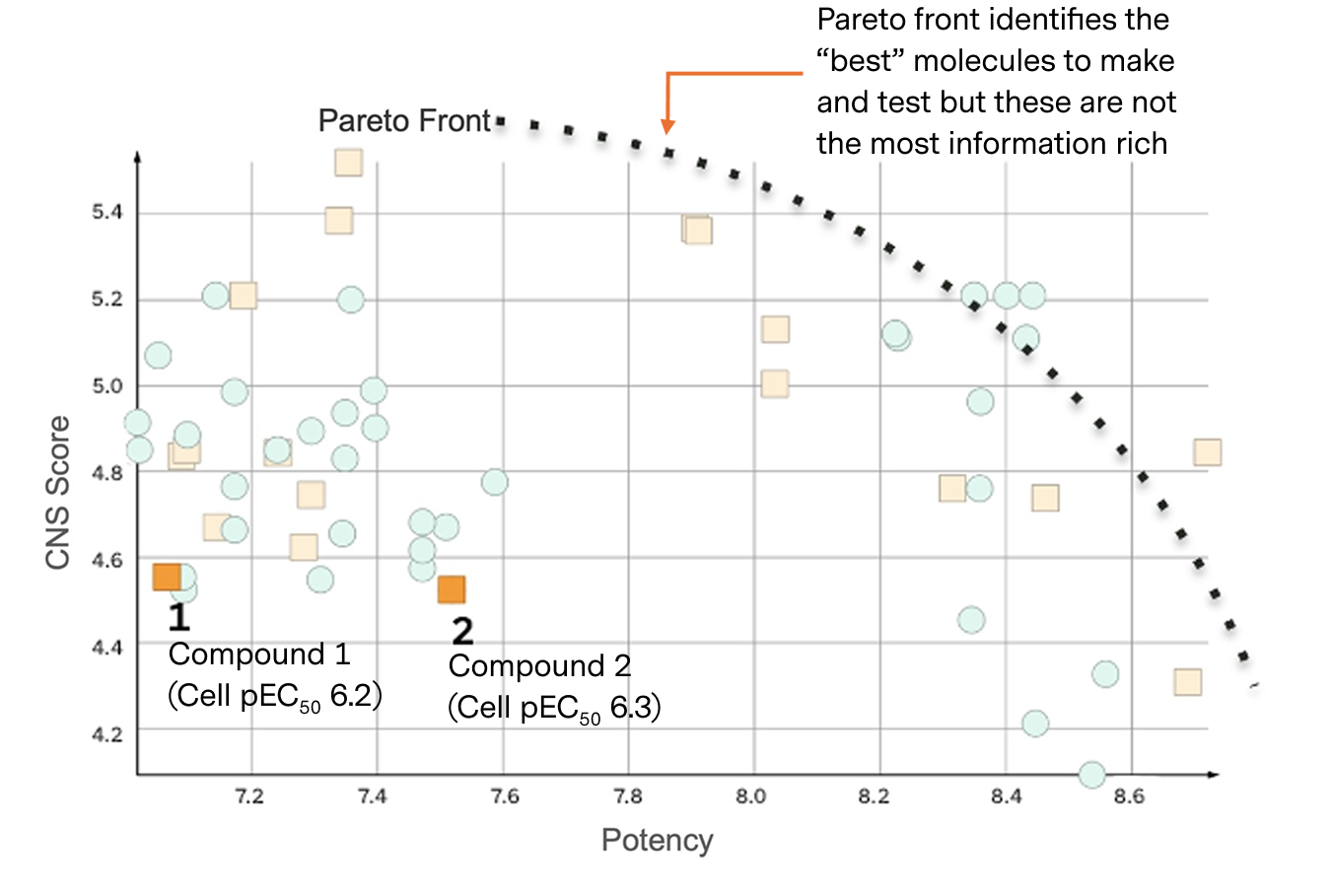
By using the platform for unbiased selection of diverse starting points, our models proposed more information-rich initial molecules away from the Pareto front (the mathematical boundary of multi-parameter optimization where one key property e.g. potency cannot be improved without degrading another e.g., safety) and led to a novel scaffold and ultimately REC-4539
The outcome:
A Potential Best-in-Class, Reversible, CNS Penetrant LSD1 Inhibitor
REC-4539 is an orally bioavailable, highly potent, and reversible LSD1 inhibitor designed to overcome the limitations that hindered previous agents and potentially be the first LSD1 inhibitor to deliver on the promise of the target:
Improved Therapeutic Index: By utilizing a reversible binding mechanism and with a shorter predicted human half-life than competitors’ current reported data, REC-4539 allows for more precise dosing. This would potentially allow for better management of on-target toxicities, thereby reducing the risk of treatment-limiting thrombocytopenia.
CNS Penetrance: Unlike earlier inhibitors, REC-4539 is specifically designed to cross the blood-brain barrier. This would potentially provide a direct mechanism to reach and impact brain metastases, addressing a primary site of disease progression in SCLC.
Preclinical Performance Combining Efficacy and Safety Signals: In a preclinical SCLC xenograft model, REC-4539 drove significant, dose-dependent tumor growth inhibition while remaining well-tolerated with minimal impact on platelet counts.
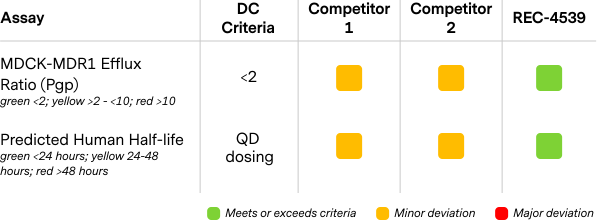
Table showing REC-4539 meets DC criteria for efflux and predicted half-life over competitors.
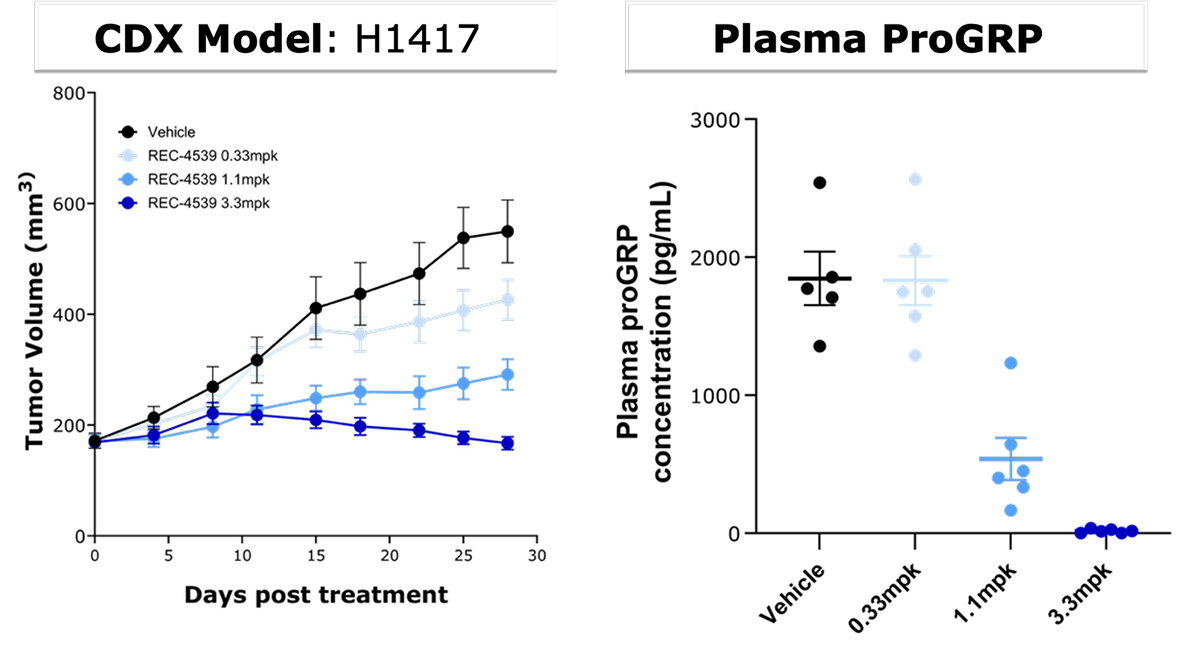
Compelling dose-dependent tumor growth inhibition demonstrated in vivo for REC-4539 in an SCLC xenograft model, correlated with a decrease in a neuroendocrine tumor biomarker proGRP.
The why:
Addressing the Unmet Need in Refractory and Metastatic Cancer
REC-4539 aims to provide a safer, more effective LSD1 inhibitor, offering a potentially new and differentiated option for patients with SCLC and other cancers who have progressed on front-line therapies, particularly those facing the high burden of brain metastases, and also patients with certain blood cancers. REC-4539 is currently under investigation in the Phase 1 ENLYGHT clinical trial for patients with solid tumors including SCLC and high-grade neuroendocrine tumors. Neither its safety nor efficacy have been established.
Learn more about clinical trials at Recursion.
Clinical trials